Businesses everywhere want to reach their customers on WhatsApp. Very few of them want to build the software to do it. They’d rather pay a monthly subscription for a tool that sends their campaigns, answers their chats and follows up with their leads.
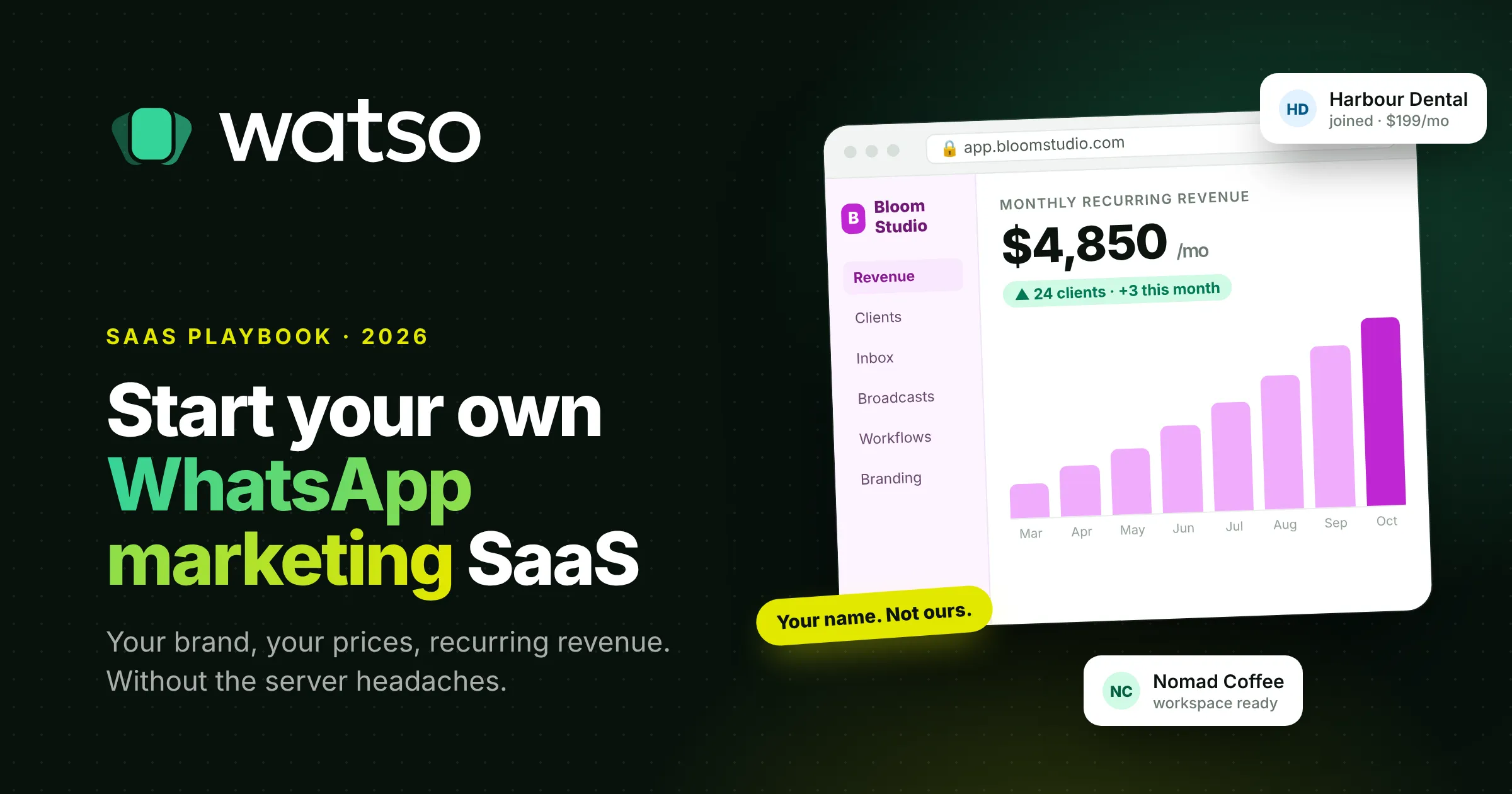
That gap is the opportunity behind a WhatsApp marketing SaaS: you run a platform under your own brand, sell subscriptions to local businesses or a niche you know well, and collect recurring revenue while they use it every day.
This guide covers why the business model works, what it takes to launch, the trap most people fall into with cheap WhatsApp SaaS scripts, and the checklist to use before you pick a foundation.
What is a WhatsApp marketing SaaS business?
A WhatsApp marketing SaaS is subscription software that lets businesses market and sell on WhatsApp: broadcast campaigns, a shared team inbox, chatbots or AI agents, automated follow-ups, contact segments and reporting. You own the customer relationship and the pricing. Your customers log in to a platform with your name, logo and domain on it.
You don’t have to write that software yourself. Most founders launch on a white-label WhatsApp marketing platform or a script they host themselves, then spend their time on what actually grows the business: finding customers and helping them succeed.
Why WhatsApp marketing SaaS is a good business to start
The demand is already there
WhatsApp has more than 3 billion monthly users, according to Meta, and in 2023 Meta said the WhatsApp Business app alone had more than 200 million monthly users. In much of Latin America, Europe, Africa, the Middle East and South Asia, WhatsApp is simply where customers expect to talk to a business.
Most of those businesses start on the free WhatsApp Business app and hit its limits quickly: broadcast lists of 256 people that only reach contacts who saved your number, one phone shared by the whole team, and no automation worth the name. That’s the moment they go looking for software. If you want the detail, our guide to sending bulk WhatsApp messages explains the limits of each option.
Recurring revenue that compounds
An agency bills per project and a freelancer sells hours. A SaaS business charges every month. Each customer you sign adds to a base that carries into the next month, so growth compounds instead of resetting. Predictable monthly revenue is also what makes a software business valuable if you ever want to sell it.
You don’t need to invent anything
Businesses already know what they want from WhatsApp marketing software: campaigns that reach the right people, an inbox the whole team can use, automation that follows up for them, and reports that show what’s working. You aren’t selling a new idea. You’re selling a reliable tool, good onboarding and local support, which is exactly where a small, focused business can beat a global vendor.
Meta runs the messaging infrastructure
Meta’s WhatsApp Cloud API handles message delivery, phone numbers and the network itself. Your platform sits on top: the interface, the automation and the experience. Your customers pay Meta’s per-message fees, and your margin is the subscription.
How a WhatsApp marketing SaaS makes money
Most WhatsApp SaaS businesses sell tiered monthly plans. A typical setup looks like this:
- Starter for a single business with one number, a small team and basic broadcasts.
- Growth with automation, AI replies, more team seats and more contacts.
- Pro or Agency with several numbers, advanced workflows and priority support.
Meta charges each business per delivered message, priced by message category and the recipient’s country. Keep that separate from your subscription so customers can see exactly what they pay you and what they pay Meta. Our WhatsApp Business API pricing guide breaks down current rates.
You can also sell setup and onboarding as a one-off fee: connecting the customer’s number, importing contacts, writing their first templates and building their first automation. For many customers that hands-on help is the reason they pick you over a self-serve global tool.
The CodeCanyon problem: why most WhatsApp SaaS scripts fall short
Search for a way to launch a WhatsApp marketing SaaS and you’ll quickly land on CodeCanyon. In October 2026, a search for “WhatsApp bulk sender” alone returns around 60 listings, and the best-known scripts have sold hundreds of copies each:
| Script on CodeCanyon | Listed price (Regular License) | Sales |
|---|---|---|
| WhatSender | $79 | ~1,500 |
| WhatsBox | $89 | ~890 |
| WhatsHam | $69 | ~820 |
| SaleBot | $59 | ~680 |
| WhatsJet SaaS | $85 | ~600 |
| WhatsML | $69 | ~225 |
| WhatsMark | $79 | ~185 |
Prices and sales as listed on CodeCanyon in October 2026. They change often.
Buy a script for under $100, install it, put your logo on it and start selling. It’s a tempting pitch. Before you do, look at what you’d actually be building on.
Unofficial WhatsApp connections put numbers at risk
Many WhatsApp scripts offer an “unofficial” connection alongside, or instead of, the official API. You scan a QR code, and the software drives a WhatsApp Web session to send messages. It’s cheaper and quicker to set up. It also breaks WhatsApp’s terms, and WhatsApp actively detects and bans automated accounts.
The scale of enforcement is large. In September 2024 alone, WhatsApp banned about 8.5 million accounts in India, according to its monthly safety report. If your customers’ numbers get banned, they lose their chat history and the number their own customers know, and you lose the customer and your reputation with them.
You become the hosting company
A CodeCanyon script is code you download and run yourself, usually a PHP or Laravel app, often with a Node.js service alongside it to keep WhatsApp sessions alive. That means provisioning a server, configuring SSL, queues, cron jobs, process managers and backups, and keeping all of it running. Many scripts say plainly that shared hosting won’t work.
Every hour you spend fixing a crashed process is an hour you aren’t selling. And when the platform goes down, your customers don’t blame the script author. They blame you.
Meta changes, and you wait for an update
Meta updates the WhatsApp Business Platform constantly. In the last eighteen months alone it moved to per-message pricing in July 2025, paused marketing messages to US numbers from April 2025, and started charging for service replies in October 2026. Each change needs software updates. With a script, you depend on the author shipping a fix, and then on yourself to install it on your server without breaking anything else.
Envato items include six months of author support, extendable for a fee. After that, or if the author moves on, you’re on your own.
The licence you actually need costs more
This one catches a lot of buyers. Envato’s Regular License only covers an end product that’s free to its users. To charge people to use the software, which is the whole point of a SaaS business, you need the Extended License, and that is usually priced many times higher than the Regular License you see advertised. Check the extended price, and ask the author whether it covers a multi-tenant SaaS, before you budget.
What you need to launch a WhatsApp marketing SaaS that lasts
Whatever you build on, check it against this list.
1. The official WhatsApp Cloud API, and nothing else. No QR codes, no “unofficial mode”, no workarounds. It’s the only foundation that protects your customers’ numbers. Bonus points if it supports Meta’s Embedded Signup, so customers connect their number in a few clicks instead of a support call.
2. Hosting you don’t have to run. Look for a platform that’s hosted, secured, backed up and updated for you, so you’re selling within days instead of configuring servers for weeks.
3. White-label that means white-label. Your logo, your colours, your domain, and no sign of the vendor’s name anywhere your customers can see it.
4. Multi-tenancy at the core. Every customer needs their own isolated workspace: their own WhatsApp numbers, contacts, campaigns, team members and data. That can’t be a bolt-on.
5. Account health in plain sight. Meta rates every number and template on quality, and low ratings lead to paused templates and restricted accounts. Your customers should see quality ratings and template approval status without logging in to WhatsApp Manager.
6. Automation customers will pay for. Keyword auto-replies aren’t enough anymore. Customers expect AI agents that can answer common questions and workflows that follow up on abandoned carts, bookings and leads on their own.
7. Analytics that prove ROI. Delivered and read counts are table stakes. Customers renew when they can see which campaigns brought replies and sales.
8. Your own pricing. You should decide your plans and prices, and keep what your customers pay you.
A launch plan for your first 90 days
- Pick a niche. Restaurants, clinics, salons, real estate, e-commerce, or a city you know. A narrow focus makes your marketing, templates and demos far more convincing.
- Set up your brand. Name, logo, domain and a simple landing page with clear pricing.
- Build a demo account with sample templates, an automation and a broadcast report for your niche, so prospects can picture their own business in it.
- Sign three to five pilot customers at a discount in exchange for feedback and a testimonial. Do their onboarding yourself.
- Turn onboarding into a playbook: connecting the number, importing contacts with consent, the first templates and the first campaign.
- Teach your customers the rules. Opt-in, segmentation and quality ratings protect their numbers and your churn rate. Our guide to bulk WhatsApp messaging without getting banned is a good starting point to share.
How Watso fits
Watso is white-label WhatsApp marketing software built for exactly this business. It connects only to Meta’s official WhatsApp Cloud API, with no QR codes or unofficial sessions. We host, secure and update the platform, so there’s no server for you to run.
Your logo, colours and custom domain go on every screen, and each customer gets an isolated workspace with a shared inbox, AI agents, broadcasts, workflows, contact segments, message templates and analytics. You set your own plans and prices and keep 100% of what your customers pay you.
The bottom line
The WhatsApp marketing SaaS opportunity is real: huge demand, a business model built on recurring revenue, and messaging infrastructure Meta already runs. The decision that matters most is what you build on. A cheap script with unofficial connections, a server to babysit and a licence that doesn’t cover reselling creates more problems than it solves. A hosted, white-label platform on the official API lets you spend your time on customers instead.
Ready to launch your own WhatsApp marketing SaaS? Watso gives you a white-label platform on Meta’s official WhatsApp Cloud API, hosted and maintained for you, with your brand on every screen. Try the live demo or get started.