WhatsApp is where customers actually reply. Messages arrive in the same app people use to talk to friends and family, so promotions, reminders and follow-ups get seen within minutes instead of sitting unopened in an inbox. With more than 3 billion people using WhatsApp every month, it’s one of the most valuable marketing channels a business can have.
The hard part is choosing the tool. Search for the best WhatsApp marketing platform and you’ll find dozens of options that look alike on the surface but work in completely different ways underneath. Some are perfect for a small shop. Some fall apart the moment you run a real campaign. Some hide the true cost per message. And some will get your number banned.
The fastest way to cut through the noise is to understand the five types of WhatsApp marketing tools, and which one fits your business.
What WhatsApp marketing can do for your business
Before comparing tools, it’s worth being clear about the jobs you’re hiring one to do:
- E-commerce: abandoned cart reminders, order and delivery updates, back-in-stock alerts and new launches.
- Service businesses: appointment reminders, quotes, booking confirmations and follow-ups after a visit.
- Lead generation: replying instantly to people who click an ad or a “Message us” button, then nurturing them until they buy.
- Customer support: answering questions in a shared inbox, with AI handling the common ones.
- Retention: loyalty offers, win-back campaigns and personal check-ins after a purchase.
The best platform for you is the one that does your most important jobs reliably, without putting your number at risk.
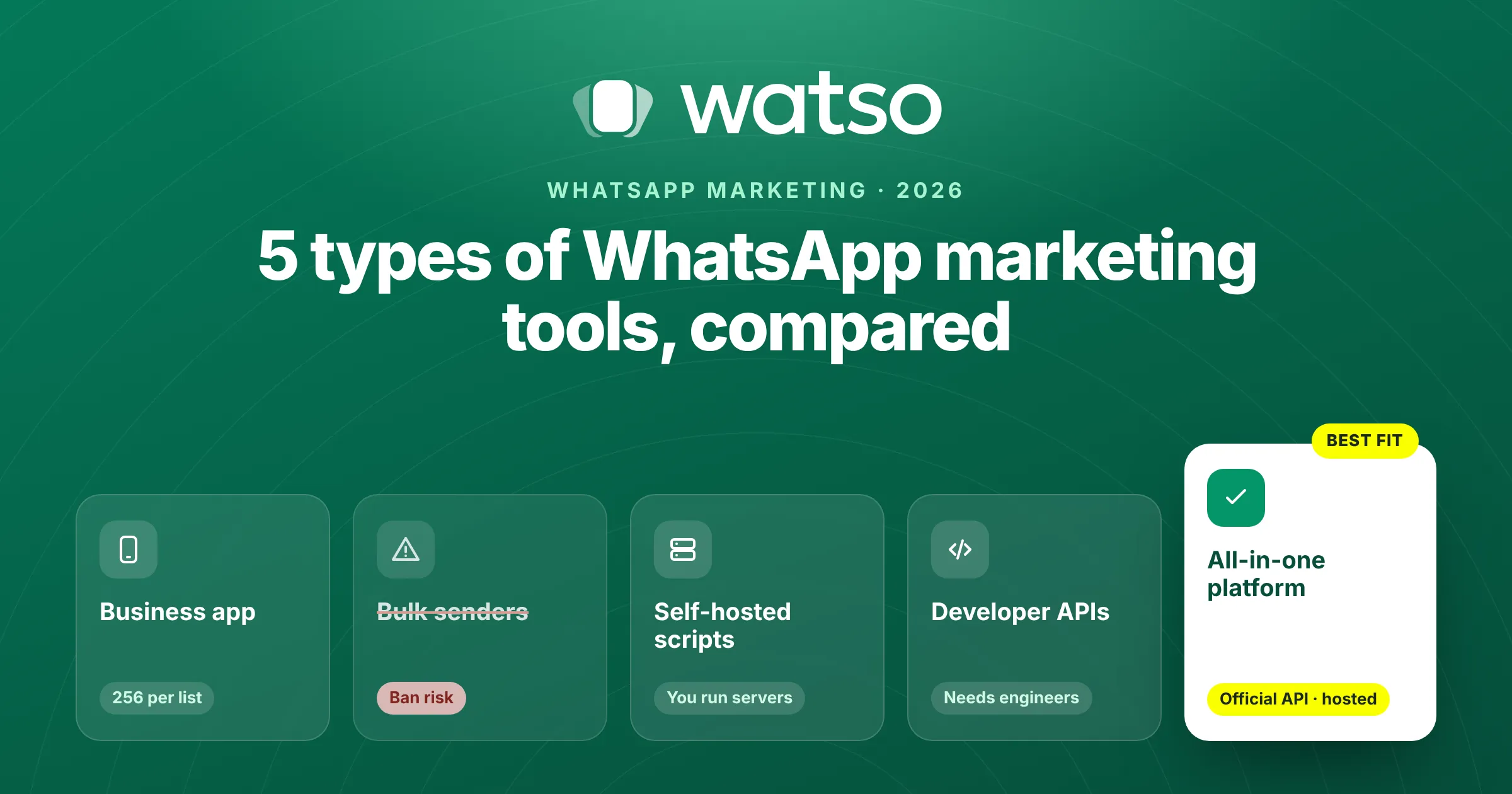
The 5 types of WhatsApp marketing tools
| Type of tool | Best for | Reach | Ban risk | Who runs it |
|---|---|---|---|---|
| WhatsApp Business app | Sole traders and very small shops | 256 per broadcast list, only people who saved your number | Low | You, on your phone |
| Unofficial bulk senders | No one | Claims to be unlimited | High | You |
| Self-hosted scripts | Developers who want to run servers | Depends on the connection used | Low to high | You, on your own server |
| Developer APIs and CPaaS | Companies with engineers | Unlimited, within Meta’s tiers | Low | Your developers |
| All-in-one WhatsApp marketing platforms | Most businesses and agencies | Unlimited, within Meta’s tiers | Low | The vendor |
1. The WhatsApp Business app
The free WhatsApp Business app gives you a business profile, quick replies, labels and broadcast lists. For a sole trader with a few hundred loyal customers, it’s a fine place to start.
Its limits arrive quickly, though. Broadcast lists hold 256 people and only reach contacts who saved your number. The whole team shares one phone. There’s no proper scheduling, segmentation, automation or reporting. Most growing businesses move on within a year.
2. Unofficial bulk senders
Browser extensions and desktop apps that “blast” messages work by automating WhatsApp Web or a modified app. They promise unlimited reach for a low one-off price.
They also break WhatsApp’s terms, and WhatsApp actively detects automated behaviour. The result is usually a banned number, along with its chat history and the trust your customers placed in it. WhatsApp bans accounts at enormous scale: about 8.5 million in India in September 2024 alone. Avoid these tools entirely.
3. Self-hosted scripts
Code marketplaces sell WhatsApp marketing scripts for under $100. You install them on your own server and maintain them yourself. Some connect to the official API, while many also offer, or rely on, a QR-code connection that carries the same ban risk as bulk senders.
Even the official-API scripts make you the hosting company: servers, SSL, background processes, backups and updates every time Meta changes something. If you’re a developer who enjoys that, it can work. If you’re running a business, it’s a second job. We cover the trade-offs in detail in how to start a WhatsApp marketing SaaS business.
4. Developer APIs and CPaaS providers
You can connect to Meta’s WhatsApp Cloud API directly, or through a communications platform such as Twilio, and build exactly what you need. It’s the most flexible option and completely compliant.
The catch is that it’s a toolkit, not a product. You’ll need developers to build the inbox, campaigns, automation and reporting, and to keep up with Meta’s changes. That makes sense for large companies with engineering teams and unusual requirements, and rarely for anyone else.
5. All-in-one WhatsApp marketing platforms
An all-in-one platform runs on the official API and gives you everything ready to use: a shared inbox, broadcasts, templates, automation, segments and analytics. The vendor handles hosting, updates and Meta’s changes.
For most businesses and agencies, this is the right answer. The question becomes which platform, and that’s where the three mistakes below come in.
The three mistakes to avoid when choosing a platform
Mistake 1: trusting a QR code connection
If a platform lets you connect your number by scanning a QR code, it isn’t using the official API for that connection, however it’s labelled. Choose a platform built exclusively on the Cloud API, where your number is registered with Meta and protected by its rules rather than at odds with them.
Mistake 2: ignoring the real cost per message
Meta charges per delivered message, priced by category and the recipient’s country, and since October 2026 that includes service replies. Some platforms pass these fees through at cost. Others add a markup or sell message credits at their own prices, which can quietly double your bill at volume. Read our WhatsApp Business API pricing guide so you know what Meta charges before you compare platforms.
Mistake 3: choosing on features you’ll never use
Long feature lists are easy to compare and mostly irrelevant. Focus on how well a platform does your two or three most important jobs, and on the things that are hard to change later: the API it uses, who hosts it, and how it prices messages. For the full list of questions to put to vendors, see our buyer’s guide to WhatsApp marketing software.
Features that separate the best WhatsApp marketing platforms
A shared team inbox. Every WhatsApp chat in one place, assigned to the right person, so no customer waits.
Broadcasts to segments, not everyone. Personalised campaigns sent to the people most likely to care, scheduled ahead and tracked live. Sending smaller, relevant campaigns is also the best protection against blocks; our guide to bulk WhatsApp messaging without getting banned explains why.
Automation with real logic. Workflows that branch on what customers do: if they click this button, send that; if they don’t reply in a day, follow up. Abandoned carts, reminders and win-backs should run on their own.
AI that handles the routine questions. Opening hours, prices, order status and bookings, answered in seconds, with a hand-off to a person when it matters. (Meta’s 2026 terms bar general-purpose AI assistants from the API, but businesses using AI to serve their own customers are still allowed.)
Compliance built in. Template approval status and your number’s quality rating visible in the product, and marketing opt-outs respected automatically.
Analytics beyond read rates. Campaign comparisons, trends over time, and ideally the replies and sales each message produced.
Integrations. Orders from your store, leads from your CRM, bookings from your calendar, plus webhooks and an API for everything else.
Where Watso fits
Watso is an all-in-one WhatsApp marketing platform built on Meta’s official WhatsApp Cloud API, with no QR codes or unofficial sessions. It’s fully hosted, so there’s nothing to install and Meta’s changes are handled for you.
It includes a shared team inbox, AI agents, broadcasts to segments, workflows, reusable message templates with images and buttons, contacts with full history, analytics and integrations with the tools businesses already use. Each business connects its own WhatsApp Business Account, so Meta bills message fees directly with no markup from us.
Watso is also fully white-label, so agencies and entrepreneurs can offer it to their own clients under their own brand and domain.
The short version
There are five kinds of WhatsApp marketing tools. The Business app is fine until you outgrow it. Unofficial bulk senders get numbers banned. Self-hosted scripts make you the hosting company. Developer APIs need a development team. For most businesses, the best WhatsApp marketing platform is an all-in-one platform on the official API that’s hosted for you, priced transparently, and strong at the two or three jobs that matter most to you.
Looking for a WhatsApp marketing platform that gets the basics right? Watso runs on Meta’s official Cloud API with a shared inbox, AI agents, broadcasts and workflows, all hosted for you. Try the live demo or get started.